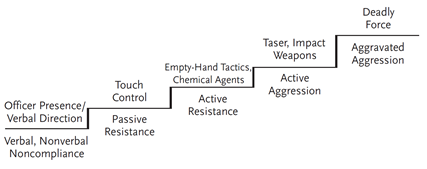
The concept of “appropriate use of force” is a guideline for responding to an attack or threat with a proportional and defensive force level. This concept is often visualized as a stairway, where different steps represent escalating levels of force, starting from minimal at the bottom to deadly at the top. The fundamental principles include:
Proportionality: You are legally permitted to use the same level of force as your attacker. This means your response must match the level of threat you are facing.
Stairway Concept: This metaphorical stairway has various levels of force, including presence, verbal commands, pepper spray, soft hands (non-injurious physical control), hard hands (strikes or kicks), and deadly force.
Defensive Force: Your use of force must always be defensive, not punitive. Even if you are scared or hurt, once the threat is neutralized, you should not continue to use force.
Minimal and Reasonable Force: The response should be minimal, using the least force necessary to stop the attack or assault. It should also be reasonable, meaning a typical person in the same situation would likely do the same.
Flexibility in Response: You do not need to move step-by-step through the levels of force. Depending on the attacker’s actions, the situation may require you to go directly from a lower level of force to a higher one.
De-escalation: If the attacker de-escalates or reduces their level of force, you must also step down your response accordingly. This aligns with the principle of using minimal and proportional force.
Contextual Decision Making: What is considered reasonable depends on what an ordinary, morally firm person would do in the same circumstances, with the same facts available.
In summary, the use of force must be proportional, defensive, minimal, and reasonable, responding appropriately to the level of threat faced without exceeding it. The concept emphasizes the need to consider the context and adjust the level of force as the situation evolves.